History of the National Lacy Dog Registry (NLDR)
The National Lacy Dog Registry (NLDR) was established to address the growing need for standardization, preservation, and sound breeding practices within the Lacy community. We support breeding programs that emphasize temperament, performance, and appearance.
The National Lacy Dog Registry is a 501(c)(3) Texas non-profit corporation, established in 2015.
Our mission is to support and promote the breeding of Lacys with the ideal type characteristics and temperament, as well as natural hunting and working abilities. To achieve this mission, the NLDR fosters sound breeding practices through research, education, record-keeping, and data analysis.
We have developed a multifaceted database that stores extensive data on each dog, including working proof, accomplishments, health info, genetics data, images, videos, and more. We will continue to leverage our data to provide new and better ways to support breeders and owners in a way that improves the breed.
In July of 2009, the NLDR partnered with the Animal Research Foundation* to reopen the original Lacy Dog stud book. The NLDR stud book is currently open. We believe that if working-type Lacy dogs are to continue, improve, and remain viable as a true working breed, a concerted effort to seek out lesser-known lines to make sure they don’t fade out is urgently needed.
The National Lacy Dog Registry (NLDR) was originally established by Betty Leek, Ft. McKavett, Texas, in August of 2008 with the guidance of long-time Lacy breeder Jimmy Brooks and other standards-focused breeders. The registry was purchased by Courtney Farris (Buvens) in 2015, who established bylaws and converted the registry to a 501(c)(3) charitable organization as of May 6th, 2015. On January 28th, 2023, elections were held, resulting in the transition of leadership of the National Lacy Dog Registry to Michael Sean Cockrell (Sean), who is currently running the registry today.
As of February 6th, Courtney has completed her promised transition period and has stepped down from her board and leadership positions. Courtney did a great job building the NLDR to its current state. Now, under the leadership of Sean Cockrell, the NLDR improved its pedigree formats, expanded its database to collect more data, and introduced new services.
One board position remains open for a key individual with influence in the Lacy world at the point when the NLDR is ready.
Current Leadership & Objectives for the NLDR
M. Sean Cockrell is a lifelong hunter who previously hunted with Labradors before buying land and founding Pecan Peak Ranch 25 years ago. Mr. Cockrell got into Lacys to serve hunting needs as well as for cattle herd management. He has been a Blue Lacy breeder for 20 years. He is a Lifetime Member of the Texas Longhorn Breeders Association of America (TLBAA.org). Mr. Cockrell raises Texas Longhorn cattle as well as Angus and Brangus cattle. These experiences give Mr. Cockrell the vision and know-how to advance the Blue Lacy breed while avoiding common setbacks that he has experienced.
Mr. Cockrell has taken steps to streamline and expand the services offered by the NLDR. He has removed politics, club membership requirements, and unnecessary steps from the registration process to make sure that NLDR services are available to all Blue Lacy Owners without prejudice towards membership affiliations and personal relationships. At the same time, Sean has added photographs, videos, and additional data to the NLDR registry files for each dog. These steps are critical for the advancement of the Blue Lacy breed, based on his experience raising dogs and cattle.
Mr. Cockrell appreciates and accepts the standards as passed forward by previous administrations. His focus is on elaborating on the base standards as originally established and supporting adherence to those standards via proof. Sean has expanded the forms of acceptable proof to include photo and video evidence in addition to the previously accepted awards, forms, etc.
*Animal Research Foundation (ARF) -The First Lacy Registry
The first registry to recognize the Lacy as an official breed was the Animal Research Foundation. An amateur genealogist with a great love for cow dogs, Tom Stodghill started the ARF in 1951 to register working English Shepherds and Catahoulas. He registered the first Lacy 1976, a male named Preston’s Big Blue, born in 1971 of Preston’s Old Blue and Preston’s Ellie.
This excerpt from a longer article tells the story of how the ARF became the original Lacy registry.
“In his magazine, [Tom Stodghill] also featured other breeds of canines than the English Shepherd and Catahoula. He wrote about Border Collies, Australian Shepherds, Australian Cattledog Queensland Heelers, etc. He reprinted letters he had received from various breeders, from his customers, and from those just seeking information. At the end of each letter, he closed with the following statement, ‘I am, very sincerely yours, Tom D. Stodghill.’
There is one thing I know for certain: we do live on a small planet after all. When you talk dogs, word can travel fast. Starting with ‘Cowboy’ Williams, the Catahoula people gravitated to Tom very quickly. In that group of Catahoula owners was Mr. J. D. Whittington. Not only did Mr. Whittington own Catahoulas, but he also knew people who owned Lacy Cowdogs. As good things are always waiting to be shared with others, someone, like Mr. Whittington or Mr. Williams, happened to tell Mr. Lee Preston about the ARF, or they handed him a back issue of our ARF Magazine and explained that he could register his ‘Lacy Cowhogdogs’ with our organization. No sooner had Mr. Preston learned about the ARF, than others, who owned the same breed, began to contact the Foundation – men such as H. C. Wilkes (from Marble Falls, Texas), Joe Bell (Buffalo, Texas), Wilson Chitwood (Terrell, Texas), Chester Wager (Lafayette, Louisiana), John McBryde (Hubbronville, Texas), Carl Wilson (Johnson City, Texas), Wylie Lee (Charlotte, Texas), Frank Perry (Throckmorton, Texas) and many, many others. All of the above-mentioned names competed in the Whittington’s Johnson City Cowdog Rodeo, and all were winners.
At the ARF Cowdog Rodeo, October 28, 1979, Mr. Wilkes made history. Tom received a phone call from a Mr. John Haskins, Refugio, Texas, wanting ‘six best ARF-Registered Cowdogs that money could buy.’ Tom told him, ‘Give me a little time, and I will fill your order.’ [In 1979, a good working dog was priced at $600.00.] Mr. Haskins wanted the dogs brought to his 100,000-acre ranch to pen cattle. Tom knew Mr. J. D. Whittington, and that he had the dogs that could pen the roughest of cows. However, when Tom phoned Mr. Whittington, he said he did not want to sell his dogs, but to phone Mr. Wilkes, as he, too, had dogs that could pen the cows. As soon as Tom got off the phone with Mr. Whittington, he phoned Mr. Wilkes and told him who wanted the dogs, and explained that he wanted him to bring his dogs to the 100,000-acre ranch and show Mr. Haskins that the dogs could pen cows.
Mr. Wilkes told Mr. Haskins that he had lived on the Lacy Family Old Pioneer Home Place, where the Lacy Cowdogs had been renowned for more than 100 years. He was thrilled to show Mr. Haskins what his Texas Lacy Cowdogs could do. Mr. Wilkes’ dogs penned 80 to 90 Brahma-type cattle. Mr. Haskins paid him $3,600.00 for six Texas Lacy Cowdogs, and also $500.00 for a good-sized Texas Lacy Cowdog pup. All were ARF Registered.”
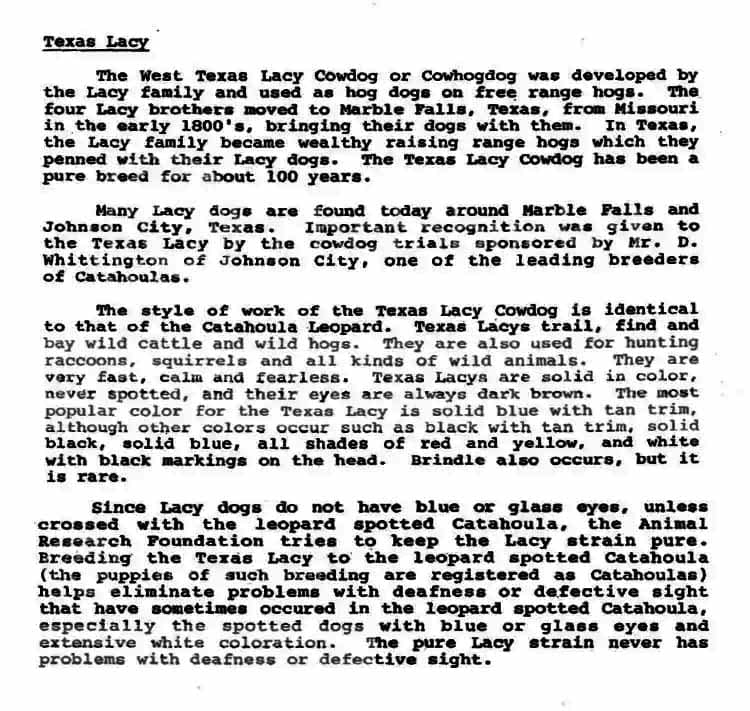
Below is a copy of the ARF’s original description for the Lacy Dog, the first written standard for the breed. Though there are discrepancies regarding color, we strive to uphold the working ability, drive, and good health described in this document.